
Traveling as a 24-Hour Non-Invasive Ventilation (NIV) User
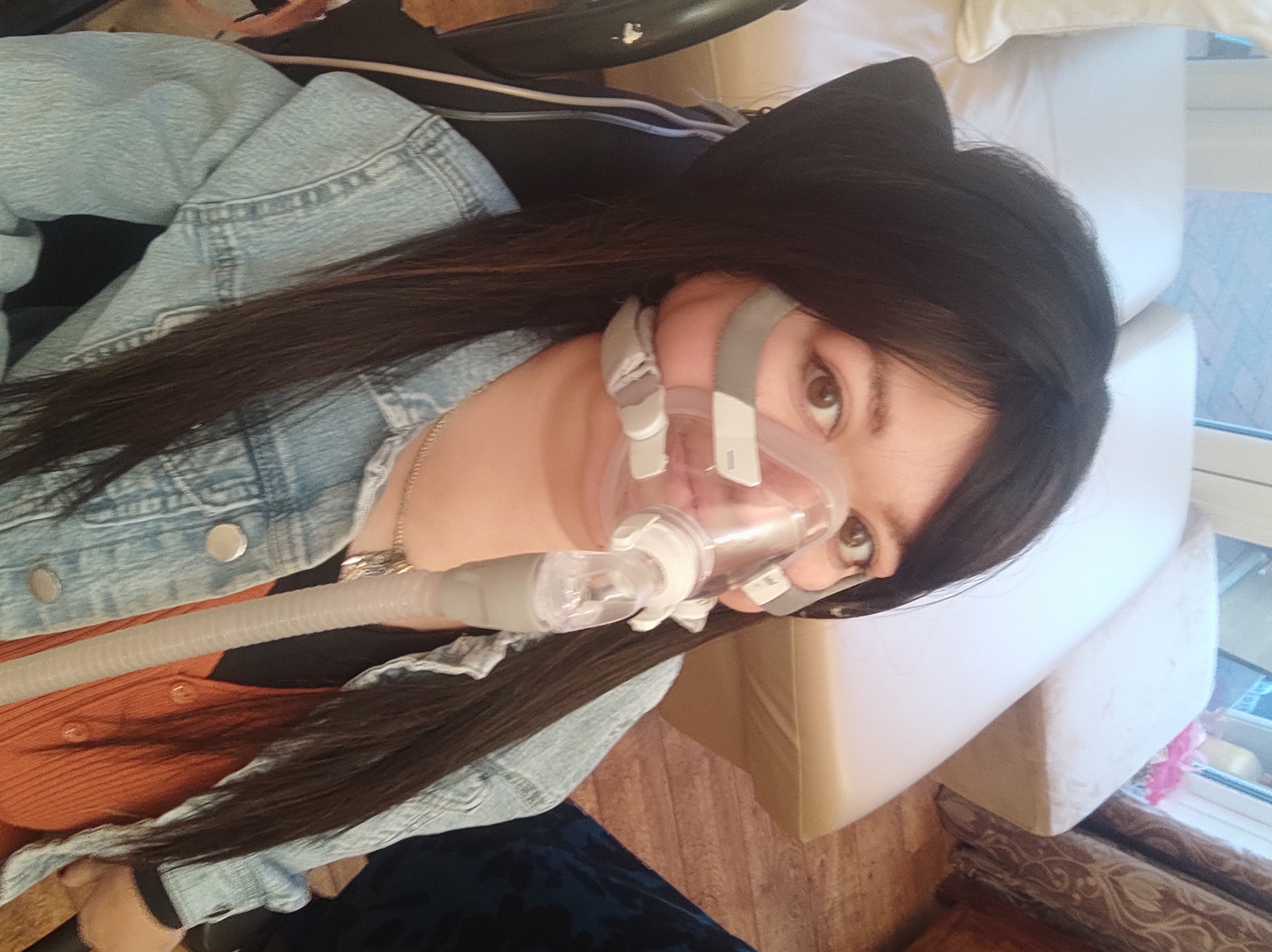

[View of snow capped mountains in Mürren, Switzerland. Jagdeep, a South Asian woman with long brown hair, is sat in her wheelchair with the snow-capped mountains behind her and bright sunlight streaming through the clouds. She is wearing her ventilator mask and an orange sleeveless dress over a black top.]
Introduction
I have Muscular Dystrophy, and as expected with muscle-wasting conditions, my health has deteriorated over time. I'm now dependent on non-invasive ventilation (NIV) 24/7. I hadn't been abroad since becoming fully NIV dependent, but Switzerland was somewhere I had always wanted to go, so I thought, “Let's try!”
There were many factors to consider, including access to electricity, battery life, accessories etc. I decided to travel by train instead of by flight because I was worried about the airline losing or breaking my wheelchair (which has happened many times in the past). Plus, as I'm also on a percutaneous endoscopic gastrostomy (PEG) feed, I needed to take liquid feed and I was concerned about getting clearance from the airline.
Planning the Journey
Firstly, I checked how long it takes to travel from Birmingham to Zurich by train. It is as follows:
Birmingham New Street to London Euston - 2 hours
London Euston to St Pancras - 10 minute walk (but with luggage we'd need a taxi, so I planned for an hour)
St Pancras to Paris Gare du Nord - 3 hours
Paris Gare du Nord to Paris Gare de Lyon - 30 minutes by taxi, but I planned for 2 hours
Paris Gare du Lyon to Zurich - 4 hours
In total a 12-hour journey. It may seem like too much time for the Euston to St Pancras, and the Paris station transfers, but I cannot overstate how important it is to have lots of time when trying to cross busy cities like London and Paris. Especially with luggage!

[View of the mountains from the train window. Jagdeep, a South Asian disabled woman who is wearing her ventilator mask and a yellow top, white cardigan and blue jeans, is looking at the view of green fields, blue sky and towering mountains glowing in the sunlight.]
Considerations
The total 12 hours of travel time would mean my ventilator battery would run out. So the next thing to do was to get extra power banks for my ventilator. I also had my second ventilator in the suitcase. This would altogether give me 30-hours of charge, which is more than enough.
I did enquire with Eurostar, just for my own information, whether the charge points on the Eurostar train could be used for charging ventilators. I was told that they would advise against this because "the electricity supply fluctuates between the UK and France and it runs at a very low voltage and at certain places on route it can dip out altogether." This poses a risk of damage to medical equipment, which is something to be aware of.
Another thing to remember is to take adapters for each country. I made sure to buy French and Swiss electric adapters. In addition, take an extension lead to ensure you have enough sockets for all your equipment. For me, that means enough sockets for 2 ventilators, 2 power banks, a Cough Assist machine, a suctioning machine, and a feeding pump. Hotel rooms wouldn't have this many sockets, so an extension lead is important. The final
thing to remember is accessories, such as extra ventilator pipes and masks, etc.
Traveling in Switzerland
Once I knew train travel to Switzerland was possible, I started searching for hotels and hiring equipment. It was a bit overwhelming, so I contacted Claire and George, a travel agency specialising in accessible holidays to Switzerland. I explained my access requirements, and together, we planned the trip - 3 nights in Zurich and 5 nights in Interlaken.
Some places we planned to visit are at higher altitude, so I had to do a hypoxic test in hospital to be safe.
The entire holiday was amazing. What made it stress-free, and saved time, was not having to book assistance as trains, trams and gondolas were level access and the buses had ramps. Miles ahead of the UK!

[Zurich's historic old town side streets with small independent shops and people walking.]
The first day in Zurich we explored the historic old town, and then we took a boat trip on Lake Zurich.

[Crystal clear water sparkling in the sunlight and cascading waterfalls over rocks.]
Day 2 we took a train to Rhein Falls, The crystal-clear water crashing over the rocks was a stunning sight!

[View from the mountain cogwheel train ascending up Mount Rigi in Switzerland. A view looking out the window of a mountain train. Blue sky with fluffy white clouds. Lush green fields, alpine trees, and mountains surrounding a bright blue lake. In the lower left corner a section of the railway track can be seen.]
Day 3 we went on a mountain cogwheel train which takes you up Mount Rigi to an elevation of 6,000 feet. At the top, the view is absolutely breathtaking: the vivid colours of the blue sky, lush green land, and majestic snow-capped mountains. We then took a boat across Lake Lucerne and a panoramic train through the Bernese Alps to Interlaken.
Day 4 and 5 we visited three villages:
Grindelwald - a picturesque mountain village nestled at the foot of the iconic Eiger glacier. With traditional wooden chalets and dramatic alpine scenery.
Lauterbrunnen - an alpine village located in a dramatic U-shaped valley. Famous for its 72 cascading waterfalls and towering limestone cliffs.
Müren - a car-free mountain village, accessible only by gondola or train. The gondola ride was a real highlight. Hanging high above the valley with 360 panoramic views of mountains, waterfalls and dramatic drops to the valley!
Our penultimate day was a relaxing day on a boat trip on Lake Brienz, a beautiful alpine lake with its striking, glacier-fed turquoise-blue waters.
And finally a bit of shopping.
The perfect end to the trip of a lifetime!

About Jagdeep
Jagdeep is a Disabled, South Asian woman from Birmingham, UK. She has muscular dystrophy and is a full- time wheelchair user and full-time NIV Ventilation user. Jagdeep is a digital artist with experience in website and graphic design. She is also a Trustee of the Muscular Dystrophy Support Centre in Coventry, supporting people with muscle-wasting conditions to
access ongoing condition-specific physical therapies and wellbeing support. Alongside that role, she is also a Community Advisory Board member of Cysters—a grassroots organization working to dismantle systemic barriers that create menstrual and reproductive health inequalities. She is also currently undertaking an Artist-Curator Fellowship with Art Riot Collective in Coventry.


Comments